The people are the Assembly. Every man and woman can help build safe, abundant communities and change the world by getting involved.
Explore the three jurisdictions, the four pillars, how people take on responsibilities and how decisions and reports return to the communities they serve.
This page explains TASA’s developing model. Detailed responsibilities and selection processes take effect through the agreed Assembly process and their governing documents. Authorisation and operation are recorded separately.
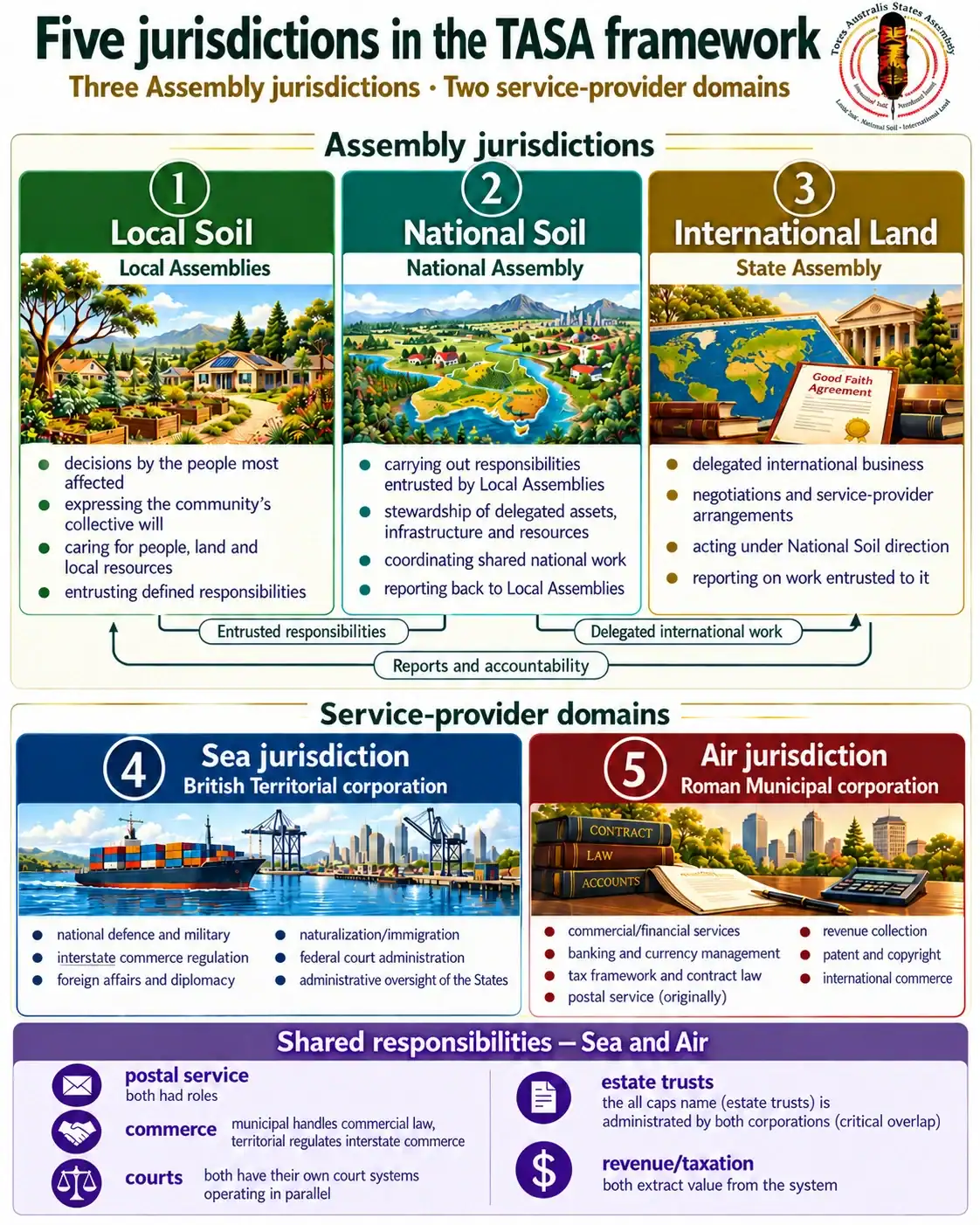
A simple example from the American Assembly model is the varying Peace Keeper roles. In the model described by Anna von Reitz and Lisa, the jurisdictions are illustrated as follows:
Jurisdiction
Illustrative role
How the model describes the work
Local Soil
Sheriff
The principal Peace Keeping Office of a Local Assembly. The model places the Sheriff at the local, County level.
National Soil
State Trooper / State Ranger
Inter-County peace keeping, including crossing Local Assembly lines to apprehend and return a person for trial.
International Land
Continental Marshal
Interstate and international matters, including trafficking, kidnapping, robbery and fraud.
Sea
Corporate County Sheriff / U.S. Marshal
Service-provider roles in the model’s Sea domain.
Air
FBI
The federal agency used to illustrate the Air domain.
Direction goes out; decisions and reports come back
All of the people domiciled within the geographical boundary of the Assembly are the Local Assembly — it cannot exist without them. We assemble to identify priorities, make shared decisions and entrust defined responsibilities to those we elect.
Similarly, the National Soil Assembly cannot exist without Local Assemblies forming. It exists when Local Assemblies work together, and when they delegate responsibilities to the national body, including stewardship of assets and resources placed in national care.
The State Assembly carries out defined international work, including interacting with and giving direction to government, under direction of the people.
Every delegation needs a purpose, limits, resources and reporting arrangements. Those entrusted with work record what they decide and do, account for what they use, and report back to the Assemblies that entrusted it. Questions beyond the mandate return for direction.
Four pillars, with a distinct role in each jurisdiction
A functioning Assembly brings together four distinct functions, often called pillars. People hear proposals, consider options and agree on action; their vote expresses their collective will. Elected Officials and Committees are entrusted to carry that direction into practice. Peace keeping addresses harm to people and property, while community preparedness helps people protect, defend and assist one another.
The functions work together across the Assembly structure. Their detailed responsibilities depend on the jurisdiction; Guardianage belongs to Soil, with local work and national support.
A Sheriff, for example, cannot fulfil the proposed role alone: the will of the people, a Court, a posse and the other pillars must support the work. The strength of the Local Assembly comes from its people participating together.
General Assembly
The General Assembly is where people receive updates, hear proposals, consider issues and make informed decisions. Those decisions express collective will and give authority for work to proceed. Who participates and what they decide depends on Local Soil, National Soil or International Land; the authority begins with the people of the Local Assemblies.
The Business Assembly puts the people’s decisions into practice and stewards the public assets, infrastructure and resources entrusted to it. At International Land, the International Business Assembly communicates the people’s direction to government service providers. Offices, Committees, processes and authority differ with each jurisdiction.
The Jural Assembly develops the Courts, trials and Peace Keeping Offices through which people uphold the Law, keep the peace and address harm to people and property. The Offices and processes depend on the jurisdiction and its defined responsibilities.
Guardianage belongs to Soil jurisdiction. Local communities prepare to protect people and property through relationships, training, emergency planning, provisions and practical help. National Soil supports this local work with shared resources, communications, training and coordination between communities.
Election to an Office, membership of a Committee and election as its Chair are three different things. Each has its own purpose and process. Nomination means putting someone forward for consideration; the relevant election process determines who takes Office.
How people are chosen for Offices
Election to a Local Office
The Local Assembly receives nominations and conducts an election under its agreed process. The Office Description and election rules should explain who may stand, who may vote, how nominations are made, the term and how the result is recorded. The Local Coroner is an example in the proposed model.
Election of National Fiduciaries
In the model being developed, each Local Assembly elects two Fiduciaries to carry its recorded direction into the National Assembly and report back. Their mandate comes from their Local Assembly and must remain clear and accountable.
Local nomination and a State election
The proposed State route begins with Local Assemblies putting forward nominees. National Fiduciaries then elect State Office holders from that pool, following the defined eligibility, nomination and election process.
Election within a Committee
Committee members elect someone to a defined responsibility within their Committee where its Charter provides for that process. For example, the proposed National Coroner Committee elects its Chair from among its members.
How Committees are formed
The preparation work today is being done by many Action Groups where people are busy researching, discussing, drafting, and preparing Office descriptions, Committee Charters and processes for the Assemblies. Once the Assemblies hold elections and are standing, the business of the Assembly is done by committees.
Through volunteering
People contribute time, skills and experience within a Committee’s defined purpose and membership arrangements. This can apply locally or nationally.
Through holding an Office
Membership may follow from holding a specified Office. Under the proposed Coroner model, every Local Coroner belongs to the National Coroner Committee.
Governance Committees
Committees required for a governance function, such as Treasury, Ombudsman or Audit, may have an elected Chair and elected voting members. Each Committee’s authorised Charter must define its actual arrangements.
Choosing the Chair
The Charter explains how the Chair is chosen, the responsibilities and term. Committee membership and Chair selection are recorded separately.
The Coroner example
In the proposed model, a Local Assembly elects its Coroner. Each Local Coroner becomes a member of the National Coroner Committee. Those members elect their Chair. The national Committee supports the Local Coroners through cooperation, shared resources and advocacy, while each Coroner remains responsible for their own work and independent findings.
This example explains the relationship; it is not a listing of an authorised or operating Office.
Why this structure exists
People need a clear and accountable way to make shared decisions and give direction to the institutions that serve them. TASA’s Assembly model draws on the principles of self-government, consent and delegated responsibility.
Defined Offices, Committees, clear records and regular reports turn those principles into practical accountability. Communities can direct the services they need and choose, follow the work, and hold those carrying responsibilities answerable.
The American founding provides one historical example: the 1776 Declaration of Independence states that governments derive their just powers from the consent of the governed; the 1783 Treaty of Paris records Britain’s recognition of the United States’ independence.
Each authorised Office, Committee or process belongs in its jurisdiction and pillar. Its entry should identify its purpose, selection or membership method, responsibilities, limits, reporting arrangements and governing document.
An authorised Office Description may still await an election. An authorised Committee Charter may still await formation. Authorisation status and operational status therefore remain separate.
Action Groups, drafts, feedback and development updates remain in Work underway, with links to completed outputs once authorised. Reference material remains available through the groups and the resource library.
Receive Assembly news, stories and ways to get involved, straight to your inbox.
Newsletter subscription privacy agreement
By entering your email details you are authorising us to store and use them for the purpose of communicating with you as part of our contact list. We commit to never share your details with anyone not authorised to administer our email subscription service.
Check your inbox or spam folder to confirm your subscription. You can unsubscribe at any time.