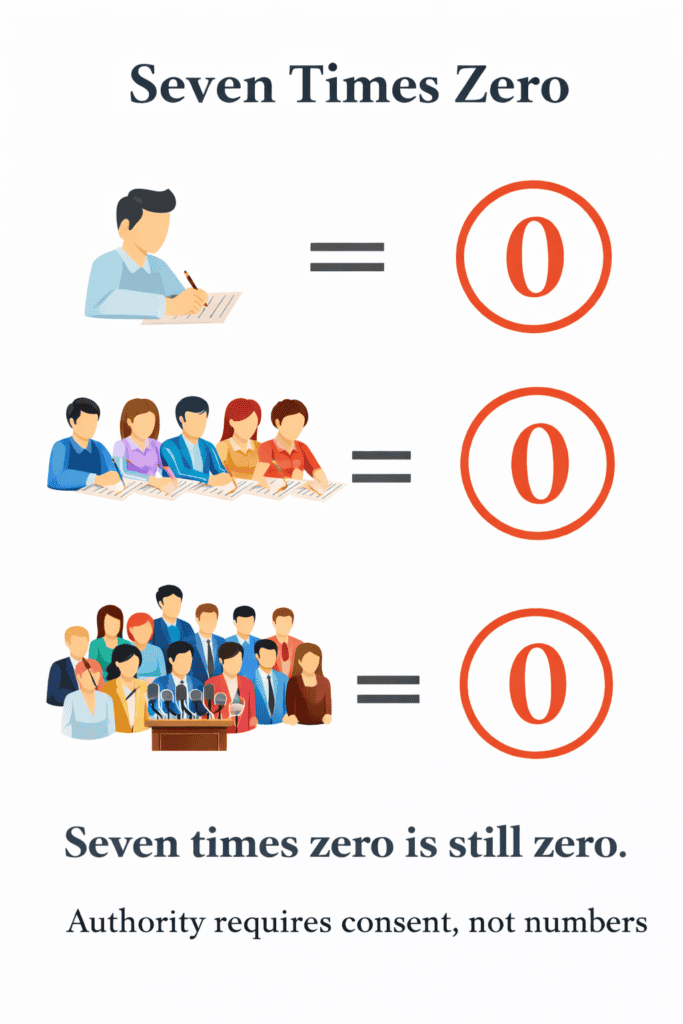
Let’s start with something disarmingly simple — a truth so plain it’s often overlooked.
If I write words on a piece of paper and tell you what to do, you are under no natural obligation to obey me.
We both know ink does not create authority.
Now, imagine I gather six friends.
We sit at a table, draft “rules,” and declare them binding.
But seven times zero is still zero.
You owe us nothing.
So we expand. We rent a hall, install microphones, print letterhead, elect officers, and call ourselves a Legislature.
Yet three-thousand times zero is still zero.
Authority does not magically appear because numbers grow.
Zero does not become one simply because it is repeated.
Authority has only one legitimate source:
Consent.
Only living, conscious, voluntary consent — given with full comprehension.
Without it, any structure, old or new, rests on the same mathematical foundation:
Zero.
An Assembly cannot compel you to do what you have not agreed to.
It is not a throne, a ruler, or a machine for issuing commands.
It is a gathering of equals.
It exists so people may express their collective will over what belongs to them together — public assets, shared infrastructure, common resources.
It is the proper means to direct the governmental services corporations that currently operate without any true accountability.
Your Assembly does not exist to dominate private conscience or control personal life.
If you choose to stand apart — as is your right — the Assembly gains no mystical power over your private life or your private property and possessions simply because it meets in a room.
That would be absurd.
Another simple truth: The Assembly does not exist to rule.
It exists for three primary purposes:
Without the people’s active participation, all administrative bodies run the risk of “drift”. If people don't engage in their Assembly, officials may expand their authority, or begin acting in their own interest. They cease serving and begin ruling.
History shows this pattern unmistakably, and while it may be done with the best of intentions (at first), it cannot happen if you are involved and vigilant.
An Assembly is how the people remain present.
It is how public servants remember they are servants.
It is how officials stay accountable to those for whom their Office exists.
A system built on compulsion must constantly enforce.
A community built on consent must constantly engage.
One relies on pressure; the other relies on participation.
The strength of an Assembly lies not in its power to compel, but in its ability to collaborate, reason, and build trust — to reach a consensus so fair and clear that people align with it voluntarily.
Freely chosen order is stronger than any imposed control.
The power of zero is not cynical.
It is freeing and enabling.
It means no one is born above another.
No title, building, robe, or uniform can manufacture moral authority.
It reminds us that legitimacy flows not from architecture, but from agreement.
And when equals gather consciously — not to dominate, but to steward what is shared — something remarkable happens.
Zero does not become tyranny.
It becomes alignment.
And alignment creates enduring strength.