What if creating a healthier and more abundant future does not require us to wait for somebody else to build it?
What if much of what we need already exists in the soil beneath our feet, in the knowledge of farmers and gardeners, in our communities, and in our willingness to participate?
In this thought-provoking presentation, farmer and author Joel Salatin challenges many of the assumptions underlying the modern industrial food system and presents something very different in its place: a decentralised, regenerative, community-based food system built around healthy soil, local production, transparency, resilience and personal participation.
His central proposition is wonderfully simple:
Rather than asking how agriculture can become ever larger and more centralised, Salatin asks what might happen if we duplicated thousands of smaller, locally appropriate solutions instead.
It is an idea that fits beautifully with the intention behind our assemblies.
The work of self-governance is not simply about establishing new structures of administration. It is ultimately about developing our capacity to care for the things upon which life depends — our land, water, food, communities, knowledge and shared inheritance — and ensuring that those things are stewarded for the benefit of everyone.
Salatin begins by reflecting on the fragility exposed when global supply chains were disrupted.
Industrial systems designed primarily around efficiency can become remarkably vulnerable when one important link fails. Large processing plants close, transport is interrupted, fertiliser becomes unavailable or prohibitively expensive, and communities far removed from food production suddenly discover how dependent they have become.
His alternative is resilience.
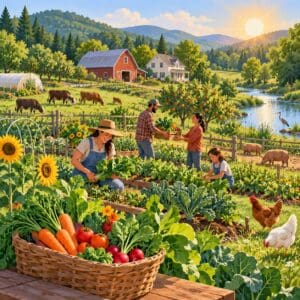
Smaller farms. Local processors. Gardens. Community-scale production. Knowledge of food preservation and cooking. Regional food networks. Farms that build fertility rather than continually importing it.
Rather than concentrating everything into a handful of enormous facilities, he asks us to imagine hundreds of thousands of smaller ones distributed throughout communities.
This is subsidiarity expressed through food: doing locally what can best be done locally.
One of Salatin's strongest challenges is to the idea that the overriding objective of agriculture should simply be producing food as cheaply as possible.
Food is not simply another commodity.
It nourishes our bodies, connects us to the earth, supports our farmers, shapes our countryside and affects the quality of the soil and water that future generations will inherit.
Salatin argues that when food is regarded merely as something to make cheaper, the true costs can disappear from view. Farmers, soil health, water quality, animal welfare, nutritional value and community resilience may all become secondary to the price appearing at the checkout.
He proposes instead that we begin thinking about “precious food” — recognising the extraordinary importance of those who grow it and of the natural systems that make its production possible.
That shift in perspective is important.
A society that genuinely regards clean water, fertile land and nourishing food as shared assets worth protecting will make very different choices from one that regards them primarily as inputs to an economic system.
Perhaps the most beautiful thread running through the presentation is Salatin's understanding of nature.
He rejects the idea that the natural world is an adversary that must constantly be subdued, controlled or corrected.
Instead:
Nature is not a reluctant partner to violently wrestle into submission.
His farming philosophy attempts to observe natural relationships and reproduce them — animals moving regularly across pasture, chickens following grazing animals, organic matter feeding soil biology, trees and vegetation becoming compost, water being retained in carbon-rich soil and biological diversity replacing monoculture.
The objective is not simply extraction.
It is regeneration.
Salatin describes soil organic matter on his own farm increasing dramatically over decades, allowing the land to retain far more water and become considerably more productive. His description of the soil as a living “cathedral”, populated by billions of interacting organisms, is a reminder that healthy land is not inert property. It is a living system.
Stewardship therefore asks a different question from exploitation.
Not merely, “What can we take from this land?”
But:
“What condition will we leave it in?”
One passage in the presentation particularly reflects the assembly intention of responsible stewardship.
Salatin describes his goal as leaving behind:
He questions an economic system that can count activity created by repairing environmental damage as economic success while failing to properly account for the damage itself.
It raises an important question for any people undertaking the responsibility of self-governance:
What do we actually mean by wealth?
If the soil is depleted, water contaminated, communities unhealthy and people dependent upon distant systems for their most basic needs, impressive financial figures tell only part of the story.
True public wealth must surely include healthy land, clean water, knowledge, productive communities, nutritious food and the ability of future generations to enjoy those things too.
These are shared assets in the deepest sense.
There is another important element running through Salatin's presentation: the restoration of practical knowledge.
These were once ordinary parts of community life. As production became increasingly specialised and centralised, much of that knowledge was gradually outsourced as well.
Salatin's response is not nostalgia.
It is participation.
He argues that independence and resilience increase when people once again understand and participate in the systems supporting their lives.
This is another area where assemblies play a beautiful role.
An assembly does not need to become the farmer, the doctor, the teacher or the scientist.
It can instead help create the conditions in which knowledge flows freely between people.
We can connect those who know with those who wish to learn.
We can support local growers.
We can encourage seed saving, community gardens, workshops, regenerative farming, food preservation, farmers' markets and local processing.
We can help identify and protect the natural assets upon which communities depend.
And most importantly, we can ensure that knowledge capable of improving people's lives is not locked away from them.
Salatin's “parallel” system is not a call for every household to become completely self-sufficient.
It is something much more practical.
Skills and resources circulate locally while larger networks remain available where they genuinely add value.
Salatin summarises the approach succinctly:
“Spread it out. Democratise it. Entrepreneurialise it.”
This mirrors an important principle of the assemblies: authority and responsibility should remain as close to the people as reasonably possible, while communities cooperate where cooperation brings benefit.
A healthy nation need not be built from one enormous system.
It can grow from thousands of capable, resilient communities connected together.
Salatin also contrasts an opaque industrial food system with one in which producers and consumers know each other.
His own farm operates with an open-door philosophy: people are encouraged to see how their food is produced and make informed choices for themselves.
That principle extends far beyond agriculture.
These are foundations not only for healthy food systems, but for healthy communities and good governance.
Perhaps the most encouraging part of Salatin's message is that his proposed alternative does not depend upon destroying an existing system before something better can emerge.
We simply begin building.
Scale comes through duplication rather than centralisation.
This is also how strong assemblies will grow.
And those communities voluntarily cooperating to accomplish the things they cannot achieve alone.
The result is not scarcity but abundance — not abundance measured simply by how much we can consume, but by how much life, capability, knowledge and natural wealth we leave behind.
Salatin closes by describing his vision as:
“an abundant solution, a people-affirming solution.”
That is perhaps why this presentation resonates so strongly with what we are building.
The assemblies have an opportunity to help steward the earth and our shared assets while clearing the pathways through which knowledge, clean food, health and practical capability can reach everyone.
Not by controlling those things.
By protecting the conditions in which they can flourish.
Not by creating dependency.
By helping people participate.
And not by waiting for someone else to build the future for us.
By beginning, locally, together, now.
Watch the video below and consider one simple question:
What could we begin doing in our own community that would leave behind more fertile soil, cleaner water, healthier food, greater knowledge and greater abundance than we inherited?