From Terra Australis States Assembly
A renewed focus on Local Assemblies and Action Group progress
How the move from INGA to iNSA is bringing fresh energy, practical support and progress to our national meetings.
Something encouraging is happening across Terra Australis.
Local Assembly Coordinators are strengthening their communities, Action Group volunteers are developing the Offices, Committees and processes our Assemblies will need, and new opportunities are emerging for everyone to learn, contribute and help move this work forward.
Recent changes to our national meetings are bringing these efforts together with a clearer focus and renewed energy.
The interim National Soil Assembly, known as iNSA, now meets in place of the former Tuesday INGA meeting.
Recognising the need for change
Since January 2026, our Interim National General Assembly meetings, known as INGA, have devoted considerable time to discussions about the wider Assembly structure and the development of our State Assembly.
This is an important discussion requiring substantial research and careful consideration. The structure we build must be practical, accountable and capable of serving the people well into the future.
In June, the Structure Implementation Committee was formed to research and evaluate the proposed arrangements, including the 1776 American model, and help determine a structure capable of meeting the needs of the people and providing lawful direction to governmental service providers.
As this work developed, structural discussions continued to occupy much of the available meeting time. Meanwhile, Action Group volunteers across Terra Australis were researching and developing documents and preparing proposals that needed opportunities for presentation, education, review and implementation.
With so much meeting time devoted to these discussions, there was less room for volunteers to share practical progress, learn from one another and receive support for the work already underway. A better balance was needed to make participation sustainable and encouraging, protect volunteers’ time and energy, and help their contributions lead to useful outcomes.
The challenge became clear: how could we give this valuable work the attention and support it needed while allowing the wider structural research to continue?
Volunteers create new opportunities
During September, volunteers began putting practical solutions in place.
Recognising that many Local Assembly Coordinators were learning new skills, from community outreach to running meetings and speaking to groups, experienced Coordinators offered to help.
A weekly Local Coordinator meeting was established, providing a welcoming space to share experiences, exchange ideas, solve problems and help one another grow their Assemblies.
At the same time, a growing number of volunteers involved in the Tuesday INGA meetings recognised the need for a stronger focus on Assembly development and the work of the Action Groups. With two weekly meetings devoted to State Assembly structure discussions, volunteers saw an opportunity to give each area of work its own space.
Following discussions among volunteers, including the long-standing INGA meeting organisers, they decided to redirect their efforts toward the Offices, Committees and processes needed by Local Assemblies and the shared responsibilities of National Soil.
The existing Tuesday INGA meeting was brought to a close, and a new meeting established in its place: the interim National Soil Assembly, known as iNSA.
The small i is deliberate and reflects the interim nature of these arrangements.
This was a choice by volunteers about where to contribute their time and how best to organise their work. It did not formally establish the future elected National Soil Assembly or impose a new structure on the wider Assembly.
The wider structural research continues alongside this practical work.
The Structure Implementation Committee continues its work examining the 1776 model and preparing the wider State Assembly arrangements, with the support of volunteers progressing the Soil work.
This approach is also in keeping with Anna von Reitz’s explanation of the distinct but connected responsibilities of Soil and International Land. Speaking about the American Assembly model, Anna explains:
“There are actually two forms of state assembly. There’s the International state assembly, okay. And then there is the assembly of the soil.”
— Anna von Reitz, American webinar Q&A
Giving the Soil work a dedicated meeting allows practical Assembly development to progress alongside the wider structural research, with each receiving the time and attention it needs. The result is a more focused approach that supports progress across Local Soil, National Soil and International Land, while keeping our shared purpose at the centre.
Three meetings, complementary responsibilities
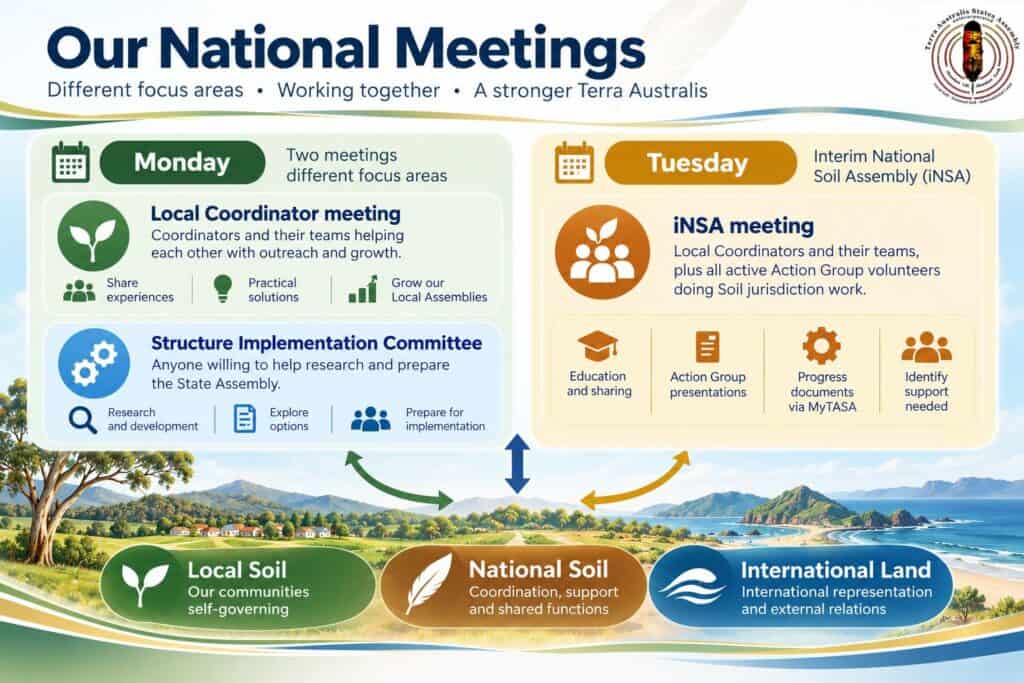
Our national meeting arrangements now provide three opportunities for volunteers to contribute, each with a distinct focus but a shared purpose.
Monday – Local Coordinator meeting
Local Assembly Coordinators and their teams come together to share experiences, celebrate successes, ask questions and help one another with outreach, community growth and the practical challenges of developing and growing functioning Local Assemblies.
Monday – Structure Implementation Committee
Open to everyone willing to contribute to researching the wider Assembly structure, examining the 1776 model and preparing the State Assembly for implementation and elections.
Tuesday – interim National Soil Assembly
Local Assembly Coordinators, their teams and active Action Group volunteers come together to learn about the Soil jurisdiction Offices, Committees and processes under development, review progress, identify priorities and offer practical assistance.
Together, these meetings create opportunities for shared learning, cooperation and steady progress without requiring every area of work to compete for the same limited meeting time.
Helping Local Assemblies stand on their own
Local Assemblies are where self-governance becomes real.
Neighbours come together to identify priorities, develop solutions, support one another and make decisions about matters affecting their communities.
Local Assembly Coordinators play a vital role in helping their Assemblies develop the knowledge, participation and capabilities needed to stand on their own, with all four pillars of self-governance functioning effectively.
The renewed meeting arrangements give Coordinators greater access to practical education, election preparation, shared resources and the experience of others.
They also create a stronger connection between Local Assemblies and the Action Groups developing the functions and resources those communities will need.
Our focus is to build from the community outward, with National Soil and International Land supporting Local Soil rather than directing it.
A clear pathway for Action Group progress
Action Group volunteers have invested enormous time and effort researching the functions, Offices and processes needed by our Assemblies.
One of the first achievements of the renewed iNSA meetings has been agreement on a clear pathway to help bring that work into practical use.
Action Groups can present their proposals in an educational format, helping attendees understand what a proposed Office, Committee or process does, why it is needed and how it will function.
Once authorised for review, the documents are made available through MyTASA for comments and expressions of support.
The Action Groups consider that feedback, report progress and bring their work forward when ready for the next stage.
This connects the volunteers developing proposals with the wider Assembly community, while giving Local Coordinators opportunities to understand the work, share it locally and identify where their Assemblies can assist.
The objective is simple: support the people doing the work and help turn good research into useful outcomes.
A promising beginning
The renewed iNSA meetings have been designed to be informative, productive and encouraging, with clear agendas, respectful participation and a 90-minute meeting limit.
Already, attendees have received updates and presentations covering Local Assembly elections, Education and Training, Document Verifier accreditation, Assembly Connect, Local Assembly websites, the Coroner Office and Guardianage Pillar training.
The early response has been heartening.
Attendees have spoken of renewed enthusiasm, enjoyable meetings, meaningful learning and the sense that practical work is moving forward again.
There is still much to develop and improve, but the first few meetings demonstrate what can happen when volunteers have a clear purpose and the opportunity to contribute constructively.
An invitation to contribute
These meetings offer opportunities for everyone who wants to help build strong, knowledgeable and active Assemblies.
Local Assembly Coordinators and their teams are encouraged to participate, share their experiences, learn from others and bring useful knowledge back to their communities.
Action Group Chairs and volunteers are encouraged to present their work, share progress and identify where additional expertise or helping hands would be welcome.
Those interested in researching and preparing the wider State Assembly structure are invited to contribute to the Structure Implementation Committee.
Everyone can also help through constructive feedback, reviewing documents on MyTASA and offering their skills wherever they are most useful.
We are building something that depends upon willing participation, shared responsibility and the contributions of many people.
The more we help one another succeed, the stronger our Assemblies become.
Our shared purpose remains unchanged: peaceful, accountable self-governance, built from our Local communities outward.
Local Soil – National Soil – International Land.
Supporting volunteers. Strengthening Local Assemblies. Moving forward together.
Shared from Terra Australis States Assembly. View the national original
Back to national updates