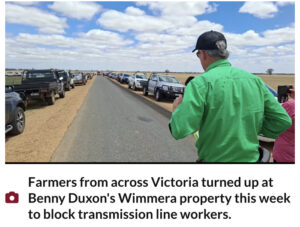
FROM the rich dairying region of South Gippsland to the cropping plains of the Wimmera, Victorian farmers are not only saying no to the massive renewables invasion of their properties, they are actively stopping it.
In the predominantly dairying district of Shady Creek, in the La Trobe Valley just north-east of the big open-cut Yallourn coal mine, almost the entire local community came out to a local hall to oppose State Government plans to build a battery factory in their area run by the multinational giant Samsung.
Meanwhile across the state in the Wimmera-Mallee, dozens of utes lined up along a country road marked the site of another blockade of Transmission Company Victoria (TCV) crews attempting to access farms for transmission line construction.
Wade Northhausen, representing the farm action group Billboard Battalion, said local farmer Benny Duxon had been instrumental in the fightback to keep the transmission companies off farmers land.
“You will see a massive crowd turn up to assist Ben and his family in stopping TCV at the boundary line at the gate and not being granted access. It will be interesting to see how TCV handle this and how things unfold today,” he said.
The State Government’s multi-billion-dollar renewables project requires multiple transmission lines to link up the various wind and solar farms and battery installations to fill the generation gaps. Farmers resent the fact that the companies involved can basically walk on to their properties and begin work with little consultation.
Landholders are sent information packs “tailored to their properties” that detail land access and easements, “project benefits” and compensation.
Back in September more than 70 people gathered at the Brim Hall to address a lack of information available about a proposed construction of the Warracknabeal and Wilkur energy parks, and associated transmission lines.
West Wind Energy’s Warracknabeal Energy Park, could include up to 230 turbines near the existing Murra Warra Wind Farm, if approvals are granted, while the Wilkur Energy Park will consist of 97 turbines on 10,554 hectares of agricultural cropping farm land, 11km south-west of Birchip.
These and various other projects must be connected by additional power lines cutting across hundreds of properties.
The seriously indebted (many would say bankrupt) Victorian Government thinks its grand plans to phase out coal-fired electricity will be some sort of economic saviour for the state, which is a seriously misguided policy given that renewables are massively low in energy density when compared with coal and oil.
According to a report published by the International Journal of Green Energy, gasoline is ten quadrillion times more energy-dense than solar radiation and one billion times more energy-dense than wind and water power.
The report notes that coal is 50 to 75% the energy density of oil, but still making it massively more energy dense than wind and solar, meaning half a dozen generators confined in a two power stations can easily run a large city like Melbourne at peak hour in addition to a string of regional cities and towns connected by one main line and feeders.
Multiple dispersed wind and solar farms by contrast, require connector lines that must be coordinated and backed up when wind and sun drop off and the generation gaps filled by gas and batteries – and the latter limited to a three or four hours at best.
An 85 megawatt solar farm and “four-hour big battery” project has already been cleared for construction in East Gippsland after being fast-tracked through the State Government’s Development Facilitation Program (DFP).
The 85 megawatt (MW) Ballantine solar farm and the 70 MW, 280 megawatt-hour (MWh) battery are being developed by UK-based Elgin Energy on farmland 3.8 km south-west of Bairnsdale, in East Gippsland.
The property that will host the project is owned by one landholder and is currently used for agricultural activities, including cattle grazing, according to planning documents.
Elgin energy is also working on a 250 MW and up to 1000 MWh battery as part of its Barwon solar farm in the Geelong district. The Barwon solar farm and Elaine solar farm and battery were subsidised last year by the federal government’s Capacity Investment Scheme – described as a swindle by MP Barnaby Joyce.
The Labor-Green Victorian government’s DFP has approved 18 new energy generation and storage projects since it was expanded to include renewables projects last year, costing nearly $5 billion and creating some 1900 new jobs.
But the cost is also the industrialisation of large swathes of farmland for the wind and solar installations and the effects of that on farm values, fire dangers from restricted aerial access due to turbines and effects on private development of land within the 1km buffer zone of the energy parks.
The State Government claims its 18 projects, once completed, will generate enough power for about 574,000 households annually, with battery storage capable of meeting evening peak demand for almost a million households.
But given all the additional infrastructure required for this system the cost may not turn out as cheap as predicted. If the all-renewables state of South Australia, with Australia’s most expensive energy, is any indicator, renewables will end up as an economic disaster for the nation.
Source:
Entire Victorian farm sector now in revolt against Labor’s renewables rollout